The Economic Pipeline:
Why Money Always Flows Upwards
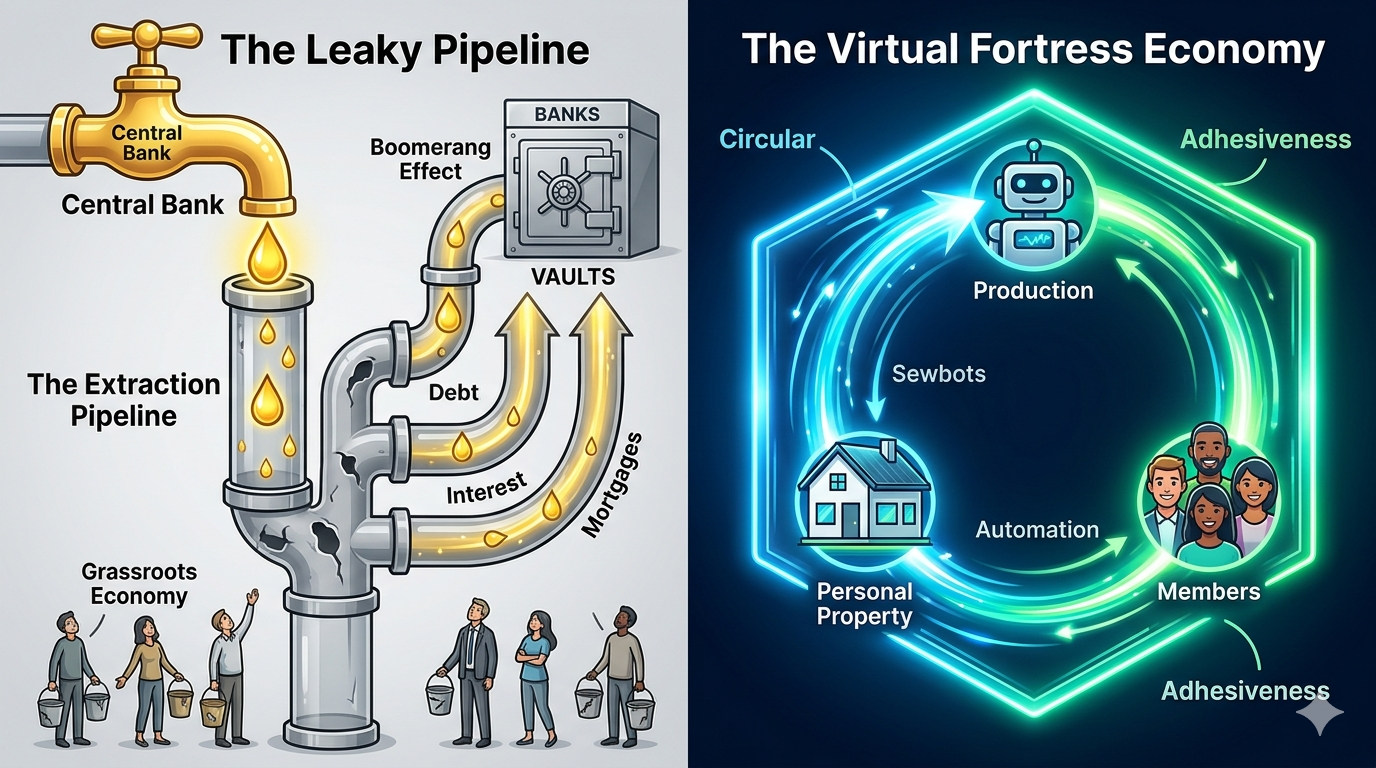
The economy is often portrayed as a pipeline — a neat structure where money flows downward from the summit to nourish the grassroots. But in reality, this pipeline leaks, bends, and boomerangs. Instead of feeding the baker, the carpenter, or the innovator, capital is siphoned back to the vaults of banks and central institutions. What looks like liquidity is in fact extraction. The image of the “Leaky Pipeline” versus the “Circular Fortress” captures this divide: one system drains life from below, while the other retains energy, circulating it among its members to build resilience.
The Introduction: The Illusion of the 'Pipeline'
Most people think of the economy as a system of pipelines. The government or the central bank pumps money into the system from above (trickle-down effect), hoping that it will trickle down to the common man. But the reality is a construction flaw: Debt.
Before capital reaches the real economy (the shop floor, the baker on the corner), the interest and the principal must already be repaid to the top. The gravitational pull of the debt is stronger than the downward flow. The result? The money makes a quick U-turn halfway down the pipeline and returns to the source. The money doesn’t flow; it is extracted.
1. The Boomerang Effect of the Summit
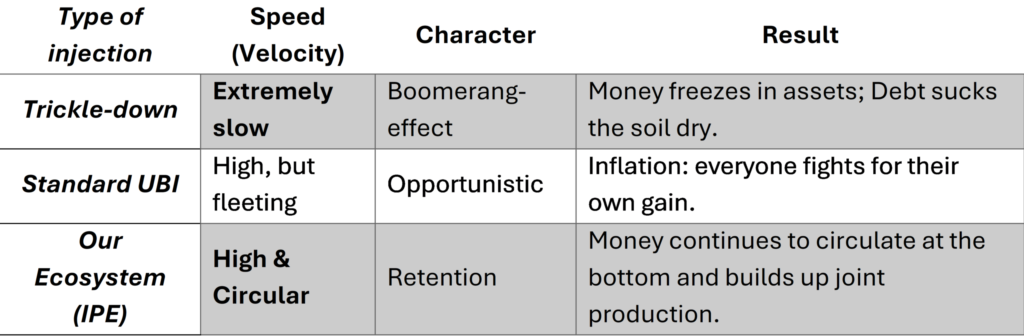
We must be honest about what is happening at the top of the pipeline. They say that liquidity is supposed to drive the “real economy,” but in fact, the velocity is extremely slow there.
- The Lump Sum Trap: Money is provided in large chunks (lump sums) to banks and large players.
- Apparent value: This money flows directly into assets such as houses. A house increases in book value, but it remains one house; no extra bricks are produced.
- The Boomerang: The consumer borrows this money, destroys its economic value by spending it on consumer goods that depreciate immediately, while the debt (the principal + interest) remains. The money gradually but inevitably returns to the source. It is a boomerang: slow in issuance, but deadly effective in return.
2. The UBI Inflation Trap
Why, then, is a universal basic income (UBI) not the solution it promises to be in the traditional economy? Because a UBI serves no common purpose in an open system.
In an economy based on scarcity, everyone is an opportunist. If every consumer gets an extra $1,000 tomorrow, the landlord, the energy supplier, or the retailer simply sees more room to raise prices. Because there is no mutual solidarity or common interest, the extra capital is immediately eaten away by price elasticity. You overfeed a scarce system with capital, and inflation always wins.
Where UBI or similar initiatives are designed to inject money into the economy from the bottom up, the effect is rarely a more stable future for households. Instead, it serves as a ‘debt collection layer.’ The middle class — small business owners, landlords, and local service providers — act as the unintended conduits for the summit. They collect the UBI from the lower tier through rent and basic expenses, only to funnel it immediately to their own banks to meet their own debt obligations. This injection doesn’t create wealth at the grassroots; it merely plugs the holes in the middle tier to ensure no gaps arise at the top. It is not social mobility; it is systemic maintenance disguised as a gift.”
3. The Paradox of the House: An Economic Black Hole
We realize that we are making a bold statement here: in the current structure, buying a house is almost a selfish act for the economy. Imagine saving up $50,000. Under current economic morality, you are a hero. But let’s look at what actually happens to the velocity of that money:
- The Freezing Phase (Savings) – For ten years, you withdraw a few hundred dollars from active circulation every month. That money “stands idle.” It does not feed the local baker; it does not pay a programmer; it does not build robots. It is dead capital waiting for a day that will never dawn in the real economy. A house in the current system is a “liability disguised as an asset”.
- The Extraction Blow (The Deposit) – Then comes the day of the purchase. You deposit that $50,000 into the seller’s account in a single lump sum. What do they do? Usually, that amount disappears immediately into another mortgage or a pension fund. The local grassroots economy sees none of it. The money has been moved from one private vault to another.
- The mortgage slavery (the Leakage) – Next, you enter into an “upward agreement” for 30 years. Every month, a huge portion of your income goes directly to the source (the bank).
- The money completely bypasses the bottom.
- It is a long-term commitment to withdraw liquidity from the consumer economy and pour it directly into the extractive pipeline of the top.
Conclusion: “In the current structure, buying a house is the ultimate form of economic selfishness: you drain decades of life energy from the community to buy a monopoly on bricks for yourself, where the profit ultimately ends up only with the bank.”
In the traditional economy, money doesn’t trickle down — it boomerangs back up.
4. The Great Short Circuit: Why a Central Bank Never Bottoms
The official narrative of central banks is that they provide commercial banks with cheap money, so that those banks can, in turn, provide loans to the baker, the carpenter, and the innovation start-up.
The Bitter Reality
The money simply does not leave the banking circuit. Instead of feeding the “real economy”, this is what happens:
- Asset Inflation (The Housing Market Bubble): Banks prefer lending for existing collateral (houses) rather than for new production. Why? Because a house is a safe ‘asset’. This money flows directly into the real estate market, drives up prices, and forces the average citizen into even higher debt to get a roof over their head.
- Stock Buybacks: Large corporations do not borrow that cheap money to build a new factory, but to buy back their own shares. The value of the shares rises; top executives collect bonuses, but the “real economy” sees not a single cent of extra circulation.
- Reserves at the Central Bank: Banks often simply deposit the money back with the Central Bank as excess reserves. It is a digital ping-pong match that the rest of the world is only allowed to watch. As a result, this money has become sterile: it does not affect the outside world whatsoever, while the citizen bears the inflationary consequences of the increased money supply in the financial sector.
The House as the Ultimate Extraction Trap
For example, when the ECB says, “We’re helping the economy,” they really mean, “We’re making sure the banks have enough liquidity to keep house prices high.”
- Citizens think they are building up assets in their home.
- In reality, they charge the battery of the financial system.
- They withdraw their own “velocity” (their daily expenses and savings) from the local economy to repay a loan based on air (the ECB injection).
The ECB is not pumping money into the ‘real economy’; it is pumping air into a real estate balloon. And the ordinary citizen is the only one who has to pay off the debt for that air through their own decisiveness, literally suffocating the local grassroots economy due to a shortage of circulating capital.
5. The Alternative: Adhesiveness in a Closed Ecosystem
This is why the architecture of our project (VFE/IPE) is different. We do not promise equality in outcomes, but equality in opportunities.
In our shielded system, we have a common goal. Here, suppliers/retailers cannot simply raise prices because the asymmetry of information is eliminated. The community sees what is happening and can ignore opportunism.
The new comparison:
Conclusion: No more sideline residents
We do not promise free housing. A house is personal property. What we provide is a basic amount that guarantees you can at least afford a roof over your head. But the real value creation — production, robotics, technology — belongs to us collectively.
Those who contribute their own value or assets as leverage for the group will benefit the most from it. We do not solve all the world’s problems, but we do ensure that there are no longer any “sideline residents” in our enclave who are left behind.
What we do is not unusual; it is done everywhere. However, there is a major difference: where your data leaked away to third parties in the “traditional” economy, we capture that data first. No personalized data will leave the Internal Project Economy (IPE). Where necessary, we will only share anonymized data with third parties. We do not promise something for free to make a lot of money later by using your data for advertisers and then keep the revenue for ourselves (Meta, to name just one example). Personal correspondence is not peeked into. If we want more data, we will request it and not surreptitiously appropriate it. Why we do not do this is because the members themselves are the “WE”.
What we do, however, is signal demand from the consumption data of all members, because that leads to production, and that is something no one can change. That is true value creation. Consequently, product output will not simply be cheaper, because no one benefits if a production company is not profitable. However, this will result in profit sharing with members as a dividend. The greatest advantage of a Virtual Fortress Economy is that you are no longer a vector in the traditional economy, but rather the bundled purchasing power that speaks.
Closing
The choice before us is stark: continue pouring life energy into a leaky pipeline that drains communities, or step inside a fortress where circulation builds resilience and shared value. The traditional economy extracts, isolates, and sterilizes; the Virtual Fortress Economy retains, energizes, and multiplies. What matters is not the illusion of flow, but the architecture of retention. In a world where pipelines always bend back to the summit, only a shielded, adhesive ecosystem can ensure that no one is left standing at the bottom with an empty bucket.