Module 2: Organizational Structure
4. Organization and the 3 Cores
This project rests on three core areas that are equal and constantly reinforcing each other. It is a choreography in which the pillars come together into one whole, but can also function independently. Together, they form a resonance that benefits everyone involved. Not by imposing value, but by offering space in which everyone can give their own meaning to value.
The three cores are Social, Economy, and Technology. The order is free: each reader decides for himself where the emphasis lies. From an organizational perspective, all cores receive equal attention. They operate independently and continue to develop separately:
- Social – because there is always a constant demand and a dynamic.
- Economics – because it is a process in motion.
- Technology – because here, stagnation equals decline.
Let’s unpack them one by one. What does each core mean for the project:
Social: the source of legitimacy and human dimension
The social core forms the foundation of this project. The starting point is the inequality that is visible worldwide: not determined by knowledge or access to networks, but by something as accidental as the location of your cradle. Completely through no fault of their own or power, people end up in circumstances from which it is difficult to escape. They are part of the economy, but are often sidelined. Their voice sounds weak or is not heard. As a result, when the economy slows down, it is precisely these groups that are disproportionately affected.
To address this, the Community Welfare Program (CWP) has been developed. A foundation of the same name carries this core. The foundation invites neighborhood communities for membership, structures micro-communities of 25 to 150 members, and verifies each member. This process is extensive, but essential: behind every membership there must be an actual person.
The foundation offers support in guidance and education. A network of field offices will be set up for this purpose. In the initial phase, each field office will serve one micro-community. As members become familiar with the project’s capabilities, one field office will support about ten micro-communities. The field offices take care of the operational activities for members; The head office focuses on the underlying processes and coordination.
To anchor the social core within a broader economic context, the project introduces the Virtual Fortress Economy (VFE). While the Community Welfare Program (CWP) ensures legitimacy and a human scale, the VFE forms the protective framework within which these communities can flourish. The VFE is designed as a safe, reciprocal structure that connects the social pillars with economic stability and resilience.
The VFE is conceived as a series of locally anchored and self-sustaining enclave economies. It begins with a micro-community; approximately ten micro-communities together form a cluster, ten clusters form a region, and ten regions form a VFE. This creates a fully-fledged local economy everywhere, with a sufficient footprint for balanced consumption and demand-driven production. By deliberately limiting the VFEs’ size, culture, and individual desires are preserved. At the same time, all VFEs together form a larger whole that cannot be ignored.
What does “virtual” mean in Virtual Fortress Economy?
The term virtual does not refer to a digital or online-only environment, but to the fact that the project does not set any physical boundaries. A Virtual Fortress Economy (VFE) is not a city wall, but a protective structure that is created as soon as people voluntarily participate. It is a fortress in the sense of protection, rhythm, and reciprocity — not of exclusion.
For example, neighborhood communities that do not participate can purchase goods and services within the VFE, but will not feel the protection when the broader fiat economy comes under pressure. The fortress is therefore virtual because it is created by choice, not by territory.
In the Klaten area, with a population of 1.3 million, we are aiming for a footprint of about 100,000 active members. That is enough to form a balanced local economy — with enough suppliers and buyers to keep consumption and production in balance, without creating monopolies. At the same time, the project must never stand in the way of the other 1.2 million inhabitants. The VFE must be able to exist alongside them, not over them.
Important issues that play a role in this are:
- Identified memberships – how do we guarantee that every member is a real human being in the age of artificial intelligence?
- Data protection – how is personal data stored securely, both public identity data and physical verification data?
- The base amount – how do we define a minimum living income that members receive each month as a starting point, and how do we ensure that this amount moves with changing circumstances?
The CWP Foundation also establishes connections with knowledge networks such as academic institutes. The social impact of the program must be continuously researched, processed, and translated into policy proposals. Where a VFE is active, communication with local authorities will also be initiated and maintained. This is all the responsibility of the social core of the project.
Economy: the heart and the engine
Economy: The economy is the heart of the project. Just as a body cannot live without a beating heart pumping blood, so the base amount cannot have meaning without an economy that circulates value. Social is the soul, technology is the bones, but without the heart, the soul also dies.
The heart is driven by the Business Development Fund (BDF), the engine of the Internal Project Economy (IPE). The BDF ensures that purchasing power not only circulates mechanically, but also acquires emotional value through destination.
Consumption and purchasing power
The consumption side of the economy follows the principles of supply and demand, in line with the ideas of Adam Smith. The strength lies in the combined purchasing power of all members. Monopolies can exist as long as they benefit consumers; Once the benefit shifts to the supplier, prices are made transparent by comparison with the broader market.
The base amount in Community Token (CT) is ammunition. Only when members can spend their CT internally — a cup of coffee, a bowl of soup, clothing to wear, a haircut — does the base amount become meaningful.
Role of the BDF
The BDF makes the marketplace accessible and frictionless.
- Digital Marketplace (CVX): Partnering with the Technology Core for a user-friendly experience.
- Physical marketplace: a diverse range, education and guidance of (re-)sellers, possibility for (re-)sellers to form micro-communities, access to capital through pillar-2 facilities.
The BDF is also starting a network of wholesalers within each VFE. This strengthens the combined purchasing power through volume purchasing.
- Structural component, directly expandable into new areas.
- Resellers and last-mile delivery ensure that even small points of sale continue to exist.
- Efficiency with 10,000 members, but can be compensated for by connecting 100+ resellers.
- Extra strategy: buy in bulk and partly resell at cost price, so that volume discounts are used.
Distribution and demand-driven production
Indonesia has shortcomings in distribution, especially in cold and frozen storage. By organizing distribution itself, the BDF can identify shortages and analyze demand without infringing on personal data.
A well-functioning marketplace forms the basis for demand analysis. The BDF focuses on four sectors that remain relevant daily:
- Textiles – clothing and footwear
- Food and beverages – food processing, beverage bottling
- Skin and health products on a natural basis
- Agriculture – with a focus on innovative cultivation techniques
Consumption generates demand, demand leads to production, and production can be scaled up by exports. Larger volumes reduce costs, increase profits, and stimulate innovation. R&D centers will be established for these sectors. Production starts in incubators and is transferred to micro-communities when viability is achieved (royalty model). If no community wants to carry out production, a Project-Owned-Company is created, which remains part of the IPE and pays royalties.
Protective wall against external shocks
The protection of the VFE consists of two layers:
- The external basket of goods and services – a doorstop that prevents inflation from the fiat economy from spilling over directly into the IPE.
- The joint combined purchasing power of the members – the true protective wall. Members can absorb the loss of income in the fiat economy through new income replacement opportunities within the IPE. Sellers cannot simply raise prices to compensate for external losses because the joint purchasing power enforces transparency. The basket also acts as a thermometer: it signals whether prices within the IPE remain the same. If a provider does try to profit, the market may ignore him and buy elsewhere.
In this way, purchasing power is not exploited but rather used as a collective buffer and benefit for all members.
Conclusion
The Internal Project Economy is not a static whole. It is a living organism, constantly in motion. The beating heart that pumps blood, circulates value, and nourishes the soul and bones of the project. The BDF is the engine that drives this heart, the marketplace is the artery that keeps CT circulating, and the combined purchasing power is the protective wall that gives members security. Without this heart, the basic amount loses meaning, but with a mature, protective, and innovative economy, the project can grow, protect, and give life.
Technology: the backbone of trust and autonomy
Technology is the backbone of the project. Where the economy is the heart and the social core is the soul, technology is the nervous system that connects, directs, and protects everything. Without a robust, decentralized, and understandable technological foundation, the project cannot function, let alone grow.
The technology core provides not only applications and infrastructure, but also the trust mechanism on which the entire project rests. No central referee, no third party that manages data, no power that rises above the members. Trust arises because the system is permissioned but decentralized: access requires membership, but output is collective and dispersed.
Network structure: from micro-community to global scale
The Internal Project Economy (IPE) runs on a Hybrid Distributed Ledger Technology (hDLT) system. Each member is part of this network through their own community relay node.
- Each micro-community manages its own access point.
- Ten micro-communities together form a hub, with a full-node and data server.
- Each community appoints a delegate to maintain the network.
This structure is both a technical scaling model and a bottom-up governance model. As the number of micro-communities grows, the network becomes not only more robust but also more democratic.
To ensure operational continuity, hubs will be equipped with field offices and, in the future, with green energy supply. Not out of idealism, but out of necessity: electricity is not guaranteed everywhere. The network must remain accessible under all circumstances.
Applications: user-first, not developer-first
The technological core develops and coordinates applications, but always from a user-first approach.
- Technology must be understandable, without falling into simplification.
- Members can choose between automatic, manual, or semi-automatic transaction execution.
- Onboarding is done via verification by the social core; technology supports, but does not replace human touch.
- The education portal is accessible to everyone, with mandatory basic modules for those who want to use the full project.
Technology is not an end in itself, but an interface between people and systems.
Interoperability: access without friction
In a world with multiple fiat currencies, each VFE will have its own Community Token (CT). To enable transactions between regions, there is a burn/mint mechanism where the Utility Token (UT) acts as a point of reference.
- The UT is not exchanged, but recognized as an anchor of value.
- The sending region burns CT worth X-amount of UT; the receiving region mints CT based on that same UT value.
- This creates an unlocking mechanism that prevents friction and breaks through isolation.
The Community Value Exchange (CVX) acts as the router for these transactions. Legally, it is a marketplace; technically functions as a payment processor.
Ease of payment and adoption
Full adoption of the CT requires ease of payment. Therefore, the technological core is developing a Prepaid Peer-to-Peer Payment System:
- Contactless payment via your own device.
- Only interact with the hDLT on balance replenishment or chargeback.
- Efficient, fast, and inclusive — even for members without crypto knowledge.
A well-functioning hDLT strengthens the sovereignty of the individual. But technology is not a self-driving car. The network belongs to the community and must also be maintained by it. If you don’t refuel, you don’t drive.
Conclusion
The technological core is not a collection of tools, but it builds tools and is a living nervous system. It carries trust, makes autonomy scalable, and connects members with each other and with the system. From relay nodes to ease of payment, from governance to energy supply — technology is the silent force that makes everything possible.
The three cores — social, economic, and technological — together form the living body of the project. The social core gives the project its soul, the economic core makes the heart beat, and the technological core connects everything through a nervous system of trust and infrastructure. Each of these cores has its own rhythm, its own responsibilities, and its own way of contributing to the community. But none of these cores operates on its own: their legitimacy, mandate, and direction are determined by the members.
That is why it is now time to reflect on the administrative logic that keeps this whole in balance. In the next chapter, we will discuss how governance, liquid democracy, and the Civic Balance Sheet together ensure rhythmic decision-making, collective legitimation, and a transparent voting model. Because only when power is shared can the project continue to breathe.
5. Governance / Liquid Democracy / Civic Balance Sheet
The three cores form the living body of the project, but without an administrative logic, this body would be rudderless. Governance is the mechanism that anchors legitimacy, gives rhythm to decision-making, and keeps power with the members. It is not a central authority that imposes rules, but a transparent system in which mandates are granted, monitored, and recalled. Governance is the way in which the community governs itself, accountable and always in balance with the social, economic, and technological pillars.
In this chapter, we elaborate on three complementary building blocks: Governance as the framework of mandate and legitimation, Liquid Democracy as the voting model that enables flexibility and direct involvement, and the Civic Balance Sheet as the instrument that safeguards accountability, transparency, and rhythmic decision-making. Together, they form the administrative heart of the project: a system that not only makes decisions but also constantly reflects and corrects, so that power never becomes silent and legitimacy always remains alive.
Governance: the breathing foundation of legitimacy
At a time when systems are ossifying, and representation is alienating, we are not building a parallel state, a market, a church — but a rhythmic ecosystem of care, infrastructure, and legitimacy. No power, no coercion, no ideology. Instead: choreography, resonance, and collective responsibility.
The voice starts with the individual.
Legitimacy does not arise at the top, but at the bottom. The voice of the individual is not an abstract right, but a rhythmic pulse, anchored in care, experience, and local bedding. Micro-communities form the first layer of densification: they choreograph their voices, nominate delegates, and determine the bandwidth of their mandate themselves.
Representation is Choreography, Not Power
Delegates do not carry power, but consent. Mandates are temporary, contextual, and are reaffirmed through feedback. No decision-making without backlash. No representation without resonance.
Decision Making: Consensus Born of Resonance
Consensus should never be forced. It arises from rhythmic condensation, not from strategic compromise. Where resonance is missing, feedback is given. Where friction arises, people listen. Where decision-making stalls, the rhythm is resumed.
Custodians: Guardians of Legitimacy
The Custodian Charter is our choreographic review body. Not a court, not a hierarchy — but a breathing body of rhythmically mandated members. They test exclusion, reputation, public funds, and monetary interventions. They choreograph resonance where friction arises, and guard the rhythm of the whole. Every year, they recalibrate themselves.
Infrastructure and monetary choreography
Each micro-community manages its own node; clusters manage hubs with energy supply. The technology core monitors the infrastructure for blockchain, data, and AI. The Community Token (CT) is tied to membership and local economy; the Utility Token (UT) forms the bridge to the outside through the lending pool. Not value extraction, but balance sheet shift.
Freedom and external relations
Membership is voluntary. Activation and withdrawal are personal choices, guided by the foundation. Farewell is not a punishment, but a ritual. External relationships are not power, but resonance: collaboration with knowledge institutes and partners, always shared and supported.
Border control and self-reflection
We do not take over tasks from the nation-state: No defense, no police, no taxation. We build infrastructure, not power. Every year, the system recalibrates itself: patterns become visible, exclusion is tested, resonance is measured. Documentation is not an archive, but a living format.
Presentation – Governance in practice
A. Structure and roles
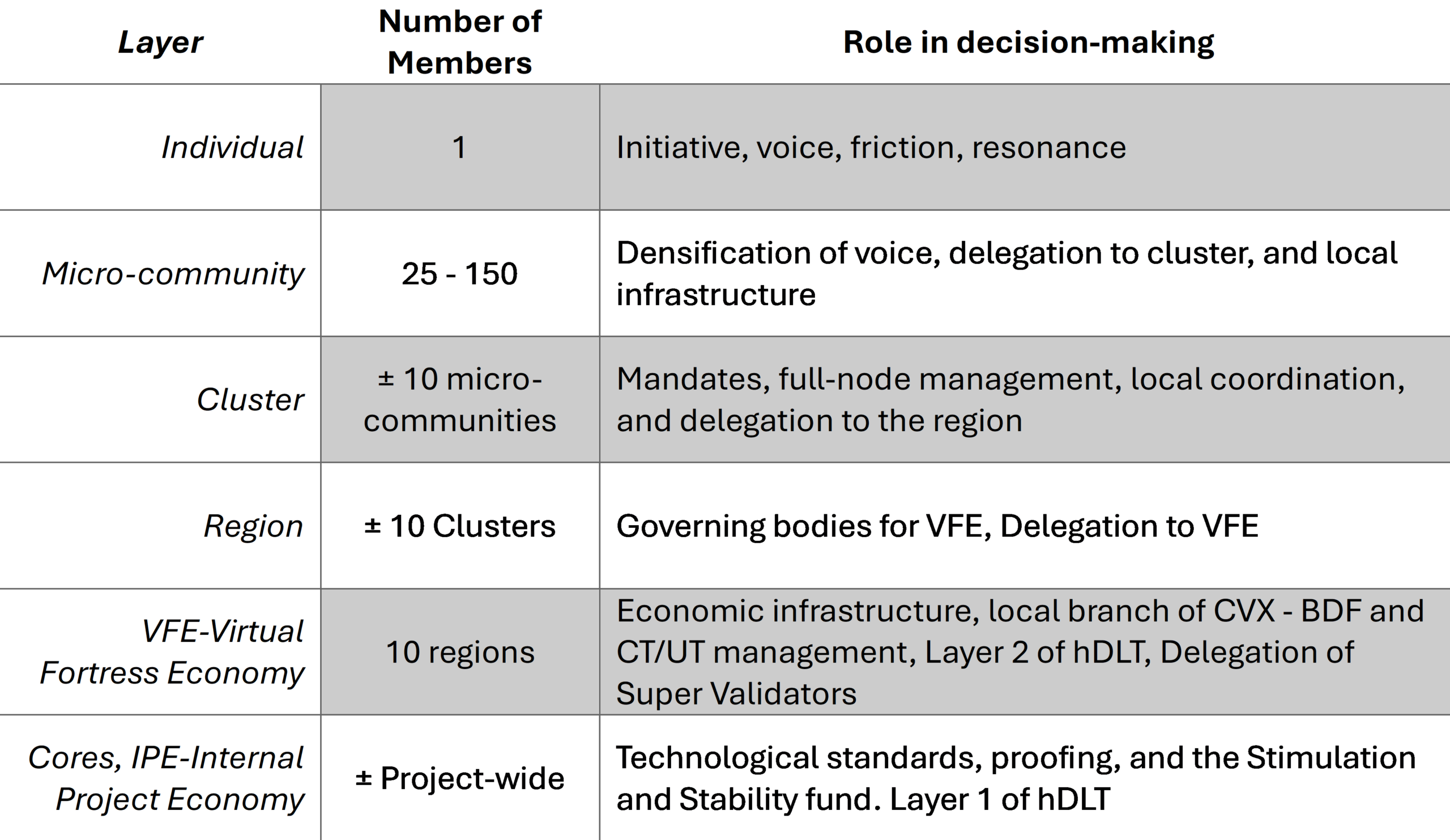
B. Decision-making in rhythm
- Initiative: comes from the bottom up, through the individual or micro-community
- Densification: micro-community choreographs the issue into a vocal field
- Mandate: delegate receives rhythmic consent within bandwidth
- Feedback: in case of exceedance or friction, back to origin
- Reconfirmation: mandate is recalibrated, not automatically renewed
- Assessment: Custodians can be called in in case of exclusion or conflict
C. Liquid Democracy – Vote as a Rhythmic Pulse
- Vote is transferable, not fixed – Members can temporarily entrust their vote to another member – Mandate is always revocable, relatable
- Mandate is contextual – A member can mandate another for care, but the infrastructure can vote for itself – No fixed representation, but choreography per theme
- Succession is rhythmic, not hierarchical – New delegates are nominated via SFU staking and verifiable draw – Reconfirmation is done through voting fields, not through elections
- Withdrawal is ritual, not loss – A member can take back his mandate, redistribute it, or let it lapse – Custodians can rhythmically test whether succession is legitimate
D. Accountability via Civic Balance Sheet
- Legitimacy is not claimed, but documented – Each layer is accountable in choreographic formats– Impact, resonance, exclusion, and infrastructure are recalibrated annually
- The Civic Balance Sheet is not accounting, but a rhythmic archive – It shows how rhythm, care, and infrastructure influence each other – It is the final piece of governance, and the opening to collective reflection
Governance is not a system of power, but a breathing mechanism that anchors legitimacy and organizes collective responsibility. The layers of decision-making are rhythmically connected, from individual to project-wide body. Custodians guard the rhythm, liquid democracy gives the voice flexibility, and the Civic Balance Sheet documents legitimacy as a living archive. Together they form the administrative heart of the project, which will be elaborated separately in the following chapters for maximum clarity and project-wide applicability.
Liquid Democracy: the vote as a rhythmic flow
Where direct democracy suffocates in scale, and representative democracy stutters in power, liquid democracy allows the vote to breathe. Where necessary, it flows directly from the individual, but can also flow temporarily to another member. Mandates are revocable, contextual, and never final. This creates a rhythm in which involvement and efficiency are not mutually exclusive, but reinforcing.
The vote is not a stone, but a stream. It can flow to another, return, divide, or rest temporarily. Liquid democracy is our response to the tension between proximity and scale: it combines the power of direct engagement with the flexibility of delegated consent. The goal is not power, but rhythm. Decision-making must breathe with the community, not freeze in hierarchy.
Liquid democracy in practice
A. Core principles:
- Portability: members can temporarily entrust their vote to someone else, but always retain the right to take it back.
- Contextuality: mandates are thematic; a member can delegate care, but vote infrastructure himself.
- Revocable: mandates are never final, always retrievable, and can be recalled.
- Rhythm: follow-up and reconfirmation do not take place through fixed elections, but through voting fields and lottery mechanisms.
B. Practical operation:
- Voting fields: issues are condensed into voting fields in which members vote directly or by mandate.
- Mandates: Deputies move within a bandwidth of consent, never with absolute power.
- Custodians: test whether succession and mandates are legitimate, and intervene in the event of exclusion or conflict.
- Withdrawal: A member can take back or redistribute their vote; this is a ritual of freedom, not loss.
C. Comparison with classic models
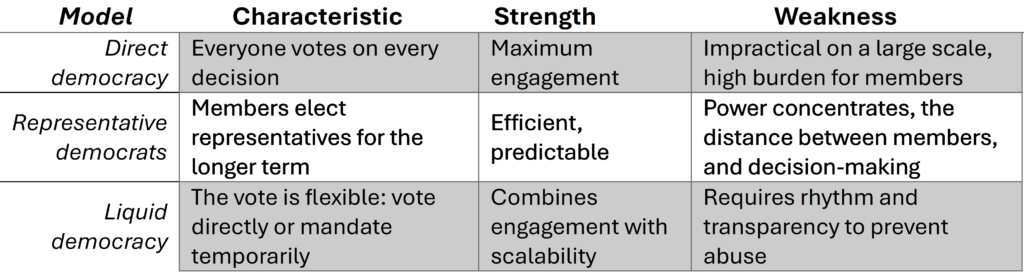
D. Bridge to hybrid Distributed Ledger
- Accountability: Liquid democracy is not only a voting model, but also a legitimation process.
- Documentation: every transfer, revocation, and compaction is recorded in the hDLT.
- Rhythm: this makes decision-making not only flexible but also transparent and verifiable.
From voice to bedding: rhythmic legitimation in motion
In a fluid democracy, voting is not an endpoint, but a rhythmic movement — a choreography of involvement, situating, and feedback. Decision-making does not arise from majorities alone, but from resonance, friction, and collective densification.
Where the voice model makes the rhythm of choice visible, the Civic Balance Sheet brings the rhythm of reflection to life. It is not a tool, not a report, not a control instrument, but a balancer: a choreographic body that weighs what has been touched, what still wants to move, and what wants to flow back to the bedding that made it possible.
The Civic Balance Sheet shows how public funds pay off — not only in terms of profit, but in terms of social cohesion, infrastructure, and learnability. It protects against abuse without punishing, guides friction without judging, and invites recovery without losing face.
In this module, the Civic Balance Sheet is positioned as a rhythmic instrument within governance: a choreography of legitimation, feedback, and collective resonance. At the same time, it fulfils the role of collective memory — an archive in which choices, reflections, and restorative movements are recorded and re-meaningized.
Civic Balance Sheet: Breathability Archive of Impact
A choreographic tool for reflection, resonance, and rhythmic legitimacy
The Civic Balance Sheet is not a scorecard, not a report, not a monitoring tool. It is a field of reflection — a choreographic body that reveals what moved, what resonated, and what remained untouched. Whereas the audit of the Stability Fund tests whether resources have been used correctly, the Civic Balance Sheet complements this by examining the impact: what has really mattered, what has learned, what has connected.
From audit to resonance
The Stability Fund has custodians who audit funds. The Stimulus Fund does not have that capacity, but the Civic Balance Sheet offers an alternative: It measures not only whether resources have been spent, but also whether they have produced results. It prevents subsidies from going to private projects or occupational therapy, and makes it visible whether workshops, training courses, or investments have actually generated resonance.
Collective memory and learning tool
The Civic Balance Sheet is an internal memory. Each member carries his own balance, as an archive of choices, reflections, and recovery movements. It helps members and micro-communities understand their impact, and provides room to learn and improve. In this way, a workshop can be sharpened, an education module deepened, a social intervention recalibrated. It is an instrument that does not punish, but accompanies — a field of care and resonance.
Application in all cores
The Civic Balance Sheet is applied to:
- Subsidies and funds: to make an impact visible and deepen legitimacy.
- Education: modules in the portal and training in micro-communities are tested for learnability and resonance.
- Sustainable investments: financial audits are also complemented by impact reflection.
- Social core: interventions and care structures are measured for cohesion and recovery.
- Technological infrastructure: nodes and hubs are assessed for accessibility and reliability.
Rhythmic effect
- Use: one-time, periodic, or cyclical, depending on role or funding.
- Custodians: choreograph rhythm and integrity, identify friction, and guide care through field offices.
- Reciprocity: commercial initiatives carry symbolic royalties in recognition of collective infrastructure.
- Transparency: making visible without exposure; showing legitimacy without comparing members.
- Zero Knowledge Proof: everyone sees that resources pay off and friction is addressed, but no one sees who received what.
Bridge to broader legitimacy
Externally, the Civic Balance Sheet is not used for assessment, but can serve as an academic window. Researchers see how legitimacy is experienced internally, how public resources pay off in cohesion and learnability, and how rhythmic care prevents abuse without punishment. In this way, the balance does not become a control tool, but a breathing proof that legitimacy can grow from internal resonance and collective responsibility.
For a practical application and formats, please see the Civic Balance Sheet template in the appendix.
Conclusion: Rhythm of legitimacy
Governance, Liquid Democracy, and the Civic Balance Sheet together do not form separate instruments, but a breathing triptych. Governance choreographs the structure, Liquid Democracy lets the voice flow, and the Civic Balance Sheet preserves the resonance as a collective memory.
Together, they make it visible that legitimacy does not arise from power or control, but from rhythm, reflection, and reciprocity. Every decision, every role, every investment returns to the bed of the community. In this way, the project will not be a collection of separate initiatives, but a living ecosystem in which care, infrastructure, and legitimacy constantly reinforce each other.
6. Custodian Charter
Custodian Charter: Rhythmic Guardians of Honesty
The Custodian Charter is not a court of law or a police service. It is an internal mechanism of care and testing, but at the same time an external signal of legitimacy: we are not only decentralized in word, but also in deed. Custodians come from the micro-communities; Each delegate is a member himself, and does not represent an organization but the members of his own community.
Their task is not to condemn, but to ensure that no one gains an unfair advantage at the expense of others. Each assignment stands on its own: auditing, conflict mediation, reputation protection, or monetary correction. What they represent is fairness — the feeling that any member, anywhere in the world, can trust that equality of opportunity is not just an expression but a reality.
Foundations of the Charter
- Mandate through micro-communities – Delegates are nominated by members, carried through SFU-staking (Sustainable Funding Unit), and fairly elected by lottery. Wrong behavior has direct reputational and financial consequences for the delegate and his micro-community.
- Access for everyone – Where two parties do not resonate, an assessment can be requested. Micro-communities receive complaints, after which a quorum is required to assess.
- Rhythmic withdrawal & resumption – Custodians may refuse cases in case of conscientious objection, relationship conflict, or lack of knowledge. Quorums may return complaints in case of inconsistency or slander — never dismiss, always invite rewording.
- Task matrix for quorum formation – Each quorum is purposefully composed and fairly selected: behavioral complaints, SFU conflicts, reputation reviews, infrastructure testing, minting audits. One case per quorum, never in parallel.
- Reputation complaints within CVX – In the event of conflicts about reviews, the other party is first given the opportunity to withdraw. Decline activates a three-month quorum. Logging makes patterns visible and prevents sabotage.
- Audit of public funds – Every tender with public funds requires a quorum audit: transparency, phase delivery, capacity, and exclusion of prestige projects. Custodians receive a budget for external expertise.
- Extraordinary minting of CT – Minting requires 75% turnout and a two-thirds majority. Custodians audit both voting and spending. For sustainable investments, pillar allocation is mandatory to prevent shocks.
- CT is local, impact is collective – CT is 1:1 pegged to local fiat. VFEs within the same area vote. Custodians guard demarcation, voting procedures, and monetary justice.
- Custodians lead, expertise supports – External audits are never leading. Custodians choreograph assessments, call in expertise where necessary, and document the process.
- Annual recalibration – The system tests itself. A mixed quorum reflects on patterns, exclusion, resonance, and impact. Custodians report to the members: what has been done, what can be improved, and what proposals are alive. In this way, the Charter remains breathable and prevents occupational therapy.
Why this Charter works
- Not judgment, but testing: Custodians choreograph resonance, not condemnation.
- Not hierarchy, but mandate: every Custodian is nominated, transparently elected, and collectively borne.
- Not rigidity, but breathing rhythm: the system recalibrates itself, documents care, and invites reciprocity.
The Custodian Charter is a choreographic compass. It protects the rhythm of the federative ecosystem, safeguards legitimacy, and invites collective responsibility. Where conflict arises, where public funds flow, where reputation is at stake, where tokens are minted — that’s where the Custodians stand. Not as judges, but as rhythmic guardians of trust.
Slot Module 2: Organizational Structure
The organizational structure of the project is not static, but a living rhythm in which three cores, decision-making, and assessment, constantly reinforce each other. The Social core (CWP) ensures care and cohesion, the Economic core (BDF) monitors sustainability and reciprocity, and the Technological core (Blockchain, hDLT & AI) anchors transparency and accessibility.
These cores are supported by Governance, Liquid Democracy, and the Civic Balance Sheet: together they form the voting model, legitimacy, and rhythmic decision-making that gives every member a voice and returns every movement to the community.
Where friction arises or public funds flow, where reputation is at stake or monetary correction is needed, there is the Custodian Charter. Not as a hierarchy, but as a choreography of care, auditing, and conflict mediation.
In this way, Module 2 as a whole breathes: a structure in which care, economy, and technology come together, in which voice and legitimacy move rhythmically, and in which testing and correction make fairness visible. The project itself is supported by the combination of Community Welfare Program (CWP) and Internal Project Economics (IPE), while the Community Value Exchange (CVX), as a marketplace, forms the bridge to intercommunal trade, exchange of labor, and future partial ownership in Project Owners.